



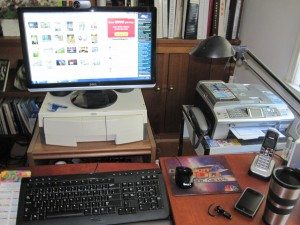
Remember when the home office meant your company’s headquarters? Many journalists never set foot in the home office, working instead from a local station, broadcast center or news bureau. But today, “home office” has an entirely different meaning for legions of journalists who freelance, work for Web outlets or run their own news sites. Working from home is both challenging and liberating. The key is to be aware of both the pluses and minuses.
A recent blog post, 7 tips to be productive when working from home, has some useful suggestions. Set goals, make schedules, avoid distractions–all good advice. But everyone’s different, and what works for Francis Tan may not work for you. “Treat your days like ‘regular’ work days,” he writes. “Many people have found that a 9-5 or 10-6 schedule really helps keep them on track and productive.” He also frowns on working in your PJs. And here I thought one advantage of working from home was the ability to set your own schedule and to wear whatever you want.
My advice? Decide what time of day is your most productive and put those hours on your work schedule. Early risers may find they get a lot of work done in the early morning hours, before anyone else is away. Night owls can be more productive after the rest of the household goes to sleep. By all means, keep some daytime “office hours” for conference calls and the like but don’t feel bound to them. Just keep your cell phone on so you can be reachable during everyone else’s office hours, even if you’re at the hardware store.
As for what you wear, I really think that’s up to you. Some folks do just fine in pajamas and slippers all day. (As the woman in the old telecommuting commercial chirped, “And I still don’t shower.”) Others need to dress up to feel business-like, at least when they’re taking work-related calls.
One point on which I completely agree with Tan: Know when to stop. Some people find that working from home means working 24/7. They answer every call, no matter how late it comes in. They respond to email on Saturday nights. It’s understandable to be anxious about having enough work when you first start freelancing, but there’s no need to overdo it. Those people who are trying to reach you are used to voice mail. Let them leave you a message. It’s OK.
What are your tips for making the most of working from home?

I host overnights on a local Christian radio station in central CT but host a daily public affairs interview show. It is a q and a format, recorded, edited and aired three times daily. I make appointments via e-mail through the night, review pitches for guests at slow moments and accept calls to my cell phone during the day after I rise at 1p. I couldn’t possibly keep up with this show, now in its 29th year, without my home office–as it is where I often am during others’ business hours. The only concession I make is working nine hour shifts Monday & Tuesday evening, before my air shift, in order to record conversations. The bulk of the “office work” is done days on my time, through e-mail at home and my cell phone.
This was a good read.
Thank you so much for this article, Deborah!
Personally, I must say that one of my main difficulties is to control the use of social networking tools. As a journalist, I DO need them to perform my tasks. However, it is quite easy to lose focus when one of your best mates just published photos of last night’s drinks at the pub or, alternatively, when one of your colleagues just shared an amazing feature on a topic that you follow!
Bearing that in mind, I would say discipline is crucial.
Cheers,
Marco
I work at home as a freelance journalist and writer for different newspapers, magazines, websites, blogs and institutions and would not trade this concept for the world. Granted, because my home office is smack in the middle of my living room–and consequently its focus–and my L-shaped desk takes up half the space, this arrangement can feel like all work, all the time. But it also affords incredible freedom. I can walk my dog, meet someone for a two-hour lunch on occasion, or keep a long dental appointment and still make a deadline, electing to compensate by working until 9 p.m. It’s my choice. There is no one looking over my shoulder, questioning every 20-minute absence from my desk as though I were a fifth grader on a 15-minute hall pass. I will say the dedication and discipline working at home requires is enormous. I often work six or seven days a week because I prefer to balance out hours of work with more personal pursuits like a mid-afternoon run or yoga class, but I really believe I got out of jail and am far more productive, motivated and accountable this way, getting to steer my own car.
I agree completely with Marco and Beth. Discipline is the key, both to get the work done and to protect some personal space and time so you don’t work 24/7. As Mario said, social networking can be a huge time suck. I find it helps to close Facebook and Twitter after a relatively brief morning foray and to check in again later in the day rather than staying plugged in all day. It helps, that is, when I remember to do it!
What I enjoy about working at home is that I don’t have to set goals, make schedules, avoid distractions, treat my days like regular work days, keep office hours or change out of my PJs. I hate goals, schedules, work days and office hours.
And I love distractions and sitting around in my PJs (which didn’t go over well when I worked in an office). In fact, the more distractions the better. I usually have either the TV or music on in the background, often both, while I work. And I work seven days a week whenever I feel like it, morning, noon or night.
The beauty of working at home is that it doesn’t feel like work. It feels like freedom.
Thanks to technology my living room has turned into a virtual newsroom. I can monitor local and distant breaking news on an internet scanner. My Final Cut Pro is my edit bay. When I record audio for a package, I do need to get in another room for better acoustics. Check the weather online radars, can even get spotter reports over internet scanner. Of course I can do email, write scripts, and monitor Facebook and Twitter for updates. Have a Yahoo RSS feed page to see what all of the media in our area are doing. I update producers and assignment desk on my status via a status line in our Opus program, or with email. And I am always a text/phone call away.
More people in house know what I am working on than all the other people based in the newsroom
Do not get the comments of coworkers often heard in a newsroom, but I am “in house” enough to keep up with people. My home office will often move other places like Panera Bread, Starbucks, or anyplace where there is a fast internet connection. That is usually close to whatever I was covering.
I do try to set boundaries, as it is very easy to work very long days. The flexible schedule is nice!
thank you for all the comments, really helps to know that im not the only one distracted by social media. Also, Im wondering if there is any of you that would be willing to help me out, Im a recent graduate and have tried to freelance in a couple of online sites with no sucess, do you guys have any suggestions?